
Skip to content
  • Home
  • Who We Are
    • About CRB
    • Governing Body
    • Team
    • Code of Conduct
    • Achievements & Affiliations
    • Annual Reports
    • Financials & Legal Documents
  • What We Do
    • Operational Verticals
    • Industry Sector
      • Agro Based Industries
      • Apparel And Textiles
      • ICT And Electronics
      • Mining and Minerals
    • Thematic Areas
      • Circular Economy
      • Business & Human Rights
      • Private Sector & SDGs
      • SMEs & Sustainability
      • Voluntary Sustainability Standards
      • Environment & Climate Change
  • Current Initiatives
    • Extreme Heat
    • Business and Human Rights Due Diligence
      • AIMprogress
      • Enhancing Circularity, Ethical Decarbonisation &
        Social Wellbeing in India’s Built Environment
      • Capability Building Tailored for Indian Suppliers
      • Awareness Raising and Capacity Building for SMEs
        on Conducting Environment and Human Rights Due Diligence
      • Self-Assessment Framework on Business & Human Rights
        for Indian Apparel & Textile Industry
      • Exploring Opportunity & Challenges to Operationalise
        Family Friendly Policies in India’s Apparel and Textile Value Chain
    • Circularity
      • Circularity in Plastics
      • Demonstrating Decarbonisation Pathways through Pilots in Textile SMEs
      • Roadmap for Circular Cluster in Ludhiana’s Apparel & Textile Sector
      • Narrative Building on Circular Economy for Sustainable Development
        in the Asia Pacific Region
      • Accelerating the Transition of the Indian Textile Sector towards Circularity
      • Landscaping Study for Food Waste in the HoReCa and Retail Segments
      • Mapping of Sustainability Certification for the Indian Textile Sector
        with Special Focus on Increasing Export Competitiveness of MSMEs
      • Circular Electronics
    • Sustainable Consumption and Lifestyles
      • An Analysis of the Assessment and Implementation
        of Green Claims
      • Analysis of Global Campaigns and their linkages
        with Mission LiFE and the Indian Ecomarks Scheme
    • Deforestation-free Commodity Supply Chains
      • Sustainability Ambassador
      • WWF Industry & Policy Engagement
        on Deforestation Free Edible Oil in India
    • EU-India Collaboration on Sustainability/SDGs
      • EU India Business Collaborative Initiative on Sustainable
        Development, Climate Action and Inclusivity
      • EU Policy and Outreach Partnership in India
    • SMEs and GHG Emission Reduction
      • MSMEs Capacity Building on Race to Net-Zero
    • Sustainable and Inclusive Agri-Value Chains
      • Promotion of Regenerative Agricultural Practices
        for a Food Secure and Climate Resilient Future
        in the EU-India Partnerships
      • Building Capacities for Augmenting Livelihood to
        Sustain the Mangrove Stewardship of Women in the
        Indian Sundarbans to Adapt to Climate Change
      • Applying Capitals Approach in Business Decision Making
        for Sustainable Agri-Food Sector
      • Continuing Professional Development
      • FPOs-Industry Interface on SDGs
      • TEEB Agri Food
    • Multi Stakeholder Platforms
      • Business & Human Rights Network
      • FOLU India CREST
      • Alliance of Cotton & Textile Stakeholders
        on Regenerative Agriculture (ACRE)
      • Coalition for Responsible Sugarcane India
      • Sustainable Palm Oil Coalition
      • VSS Collaboration India
      • India Sustainability Standards (ISS)
    • Youth Engagement on Sustainability (YES)
      • Youth for Sustainability (YfS) India Alliance
      • Engagement & Representations
      • Youth for Sustainable Palm Oil Fellowship
  • G20
  • Knowledge Hub
    • Blog
    • Newsroom
    • Publications
    • Events & Updates
  • Careers
  • Home
  • Who We Are
    • About CRB
    • Governing Body
    • Team
    • Code of Conduct
    • Achievements & Affiliations
    • Annual Reports
    • Financials & Legal Documents
  • What We Do
    • Operational Verticals
    • Industry Sector
      • Agro Based Industries
      • Apparel And Textiles
      • ICT And Electronics
      • Mining and Minerals
    • Thematic Areas
      • Circular Economy
      • Business & Human Rights
      • Private Sector & SDGs
      • SMEs & Sustainability
      • Voluntary Sustainability Standards
      • Environment & Climate Change
  • Current Initiatives
    • Extreme Heat
    • Business and Human Rights Due Diligence
      • AIMprogress
      • Enhancing Circularity, Ethical Decarbonisation &
        Social Wellbeing in India’s Built Environment
      • Capability Building Tailored for Indian Suppliers
      • Awareness Raising and Capacity Building for SMEs
        on Conducting Environment and Human Rights Due Diligence
      • Self-Assessment Framework on Business & Human Rights
        for Indian Apparel & Textile Industry
      • Exploring Opportunity & Challenges to Operationalise
        Family Friendly Policies in India’s Apparel and Textile Value Chain
    • Circularity
      • Circularity in Plastics
      • Demonstrating Decarbonisation Pathways through Pilots in Textile SMEs
      • Roadmap for Circular Cluster in Ludhiana’s Apparel & Textile Sector
      • Narrative Building on Circular Economy for Sustainable Development
        in the Asia Pacific Region
      • Accelerating the Transition of the Indian Textile Sector towards Circularity
      • Landscaping Study for Food Waste in the HoReCa and Retail Segments
      • Mapping of Sustainability Certification for the Indian Textile Sector
        with Special Focus on Increasing Export Competitiveness of MSMEs
      • Circular Electronics
    • Sustainable Consumption and Lifestyles
      • An Analysis of the Assessment and Implementation
        of Green Claims
      • Analysis of Global Campaigns and their linkages
        with Mission LiFE and the Indian Ecomarks Scheme
    • Deforestation-free Commodity Supply Chains
      • Sustainability Ambassador
      • WWF Industry & Policy Engagement
        on Deforestation Free Edible Oil in India
    • EU-India Collaboration on Sustainability/SDGs
      • EU India Business Collaborative Initiative on Sustainable
        Development, Climate Action and Inclusivity
      • EU Policy and Outreach Partnership in India
    • SMEs and GHG Emission Reduction
      • MSMEs Capacity Building on Race to Net-Zero
    • Sustainable and Inclusive Agri-Value Chains
      • Promotion of Regenerative Agricultural Practices
        for a Food Secure and Climate Resilient Future
        in the EU-India Partnerships
      • Building Capacities for Augmenting Livelihood to
        Sustain the Mangrove Stewardship of Women in the
        Indian Sundarbans to Adapt to Climate Change
      • Applying Capitals Approach in Business Decision Making
        for Sustainable Agri-Food Sector
      • Continuing Professional Development
      • FPOs-Industry Interface on SDGs
      • TEEB Agri Food
    • Multi Stakeholder Platforms
      • Business & Human Rights Network
      • FOLU India CREST
      • Alliance of Cotton & Textile Stakeholders
        on Regenerative Agriculture (ACRE)
      • Coalition for Responsible Sugarcane India
      • Sustainable Palm Oil Coalition
      • VSS Collaboration India
      • India Sustainability Standards (ISS)
    • Youth Engagement on Sustainability (YES)
      • Youth for Sustainability (YfS) India Alliance
      • Engagement & Representations
      • Youth for Sustainable Palm Oil Fellowship
  • G20
  • Knowledge Hub
    • Blog
    • Newsroom
    • Publications
    • Events & Updates
  • Careers

Navigating Compliance & Sustainability: SMEs in Global Value Chains

  • December 21, 2023

share this

Picture of Shubham Trivedi

Shubham Trivedi

Shubham Trivedi is a consultant at the Centre for Responsible Business, with interests in the field of Responsible Business. He holds an MBA in Sustainable Development and Management from Nalanda University.

Consultant at the Centre for Responsible Business

Linkedin

Navigating Compliance & Sustainability: SMEs in Global Value Chains

Will ESG regulations on global value chains safeguard or stifle SMEs in emerging economies/global south? Explore how compliance demands might pose opportunities and challenges for small businesses navigating these interconnected networks. Unveil the delicate balance between growth and challenges within this evolving landscape.

In the ever-evolving landscape of global commerce, the intricate web of global value chains stands as a cornerstone. These chains encapsulate every facet of a product or service’s journey, spanning from its inception to its utilization and beyond. Local entities, often small and medium-sized enterprises (SMEs), find themselves deeply intertwined with larger foreign enterprises, engaging in supply and subcontracting. For developing economies, integration into these value chains has been instrumental in accelerating economic progress and in meeting development priorities.

However, these global value chains extend beyond borders, presenting environmental and human rights challenges. The diagram below provides a simplified overview of stakeholders and potential human rights impacts within these interconnected chains.
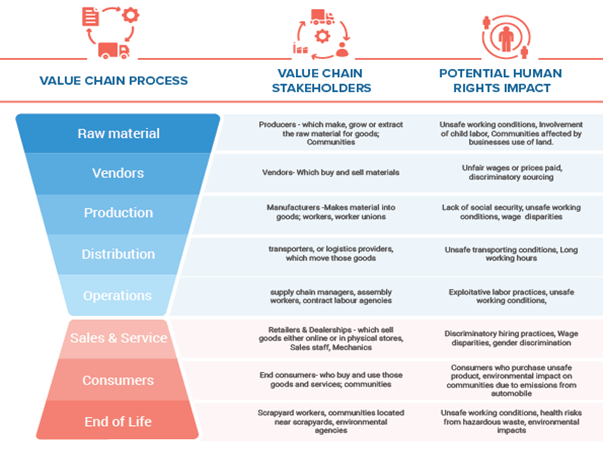
Aside from the human rights considerations, SMEs encounter a plethora of hurdles within global value chains. These challenges include limited access to financing, a shortage of skilled labor, insufficient institutional support, and heightened compliance requirements. Particularly in regions like Germany (Lieferkettengesetz) and the European Union (Corporate Sustainable Due Diligence Directive), impending legislations pose significant obstacles for SMEs. Given their constrained resources, SMEs find it challenging to identify, address, and rectify these issues. Reports from organizations like Sweden’s National Board of Trade highlight the difficulties suppliers face in meeting the rigorous due diligence standards set by EU companies, potentially resulting in severed ties or exclusion from the lucrative EU market.

Against this backdrop, the Business and Human Rights Network, in collaboration with FNF South Asia and the Centre for Responsible Business, conducted a webinar titled “Global Sustainable Value Chains: Prospects and Obstacles for South Asian SMEs”.
The opening remarks by Rijit Sengupta, Chief Executive Officer at the Centre for Responsible Business, underscored the convergence of agendas between the UN Forum on Business and Human Rights in Geneva and the Paris climate community. He advocated for collaboration between the Global North and South, acknowledging India’s strides in responsible business practices.

The keynote address delivered by Carl-Julius Cronenberg, Member of Parliament, Germany, highlighted India’s growing significance and the opportunities for small and medium-sized companies in diversifying supply chains. He also acknowledged sustainability as a competitive advantage in European markets, expressing concerns about potential bureaucratic hurdles due to stringent regulations. He urged for balanced regulation without hampering trade relationships and encouraged discussions for mutual growth and development between Germany and India.
Special remarks by Pradeep Ramakrishnan, General Manager at Securities and Exchange Board of India (SEBI), highlighted India’s robust regulatory framework for Environmental, Social, and Governance (ESG) factors, focusing on non-financial disclosures and initiatives contributing to India’s leadership in Corporate Governance. He also mentioned BRSR and BRSR Core as credible information sources for stakeholders.

The panel discussion included Nusrat Khan, BHR Specialist, UNDP India; Mr. Anil Bharadwaj, Federation of Indian Micro and Small & Medium Enterprises (FISME), India; Mr. Shiham Marikar, SG, National Chamber of Exporters (NCE), Sri Lanka and was moderated by Nandini Sharma, Director, Centre for Responsible Business .

Here are key points covered by the panel:

  1. SME Significance: Acknowledged the vital role of SMEs in the economy but stressed the need for education on ethical trading and regulatory compliance.
  2. Challenges Faced: Noted hurdles like compliance costs, unclear regulations, and uncertainties, especially during events like the COVID-19 pandemic.
  3. Clarity and Capacity Building: Emphasized the necessity for clear laws, capacity building, and awareness to assist SMEs in understanding and complying with evolving regulations, particularly in the Global South.
  4. Role of Larger Brands: Urged larger companies to set positive standards that influence SMEs in their supply chains, emphasizing buyer responsibility.
  5. Legislative Reforms: Highlighted the importance of clear laws, robust execution, and updating outdated labour and environmental regulations.
  6. Incentivizing Compliance: Proposed incentivizing SMEs to adhere to ethical standards for better compliance, not just relying on penalties.
  7. Sustainable Business Models: Encouraged a shift to sustainable business models beyond profit-centric approaches.
  8. Continual Dialogue: Emphasized the need for ongoing discussions involving stakeholders for effective solutions.
  9. Acknowledging Technical Issues: Speakers apologized for technical difficulties and assured content accessibility post-event.

In conclusion, SMEs play a pivotal role in global value chains, offering both vast opportunities and risks. Addressing these risks and challenges requires a collective effort from policymakers, industry stakeholders, and SMEs themselves. Empowering SMEs to overcome these hurdles will not only fortify their growth but also contribute to the sustainable and inclusive development of global economies.

For more such insights, follow us on


“NOTE: The views expressed here are those of the authors and do not necessarily represent or reflect the views of CRB.”

Regenerative Agriculture can be a Promising Path for Soybean Cultivation

How Capitals Approach can strengthen India’s push for sustainable agriculture

Driving Sustainable Change in the Textile Sector through Consumer Choices

How Indian MSMEs are leading the integration of environmental sustainability into their operations

Sustaining Rainforests Through Smarter Choices: Sustainable Palm Oil, India, and Consumers

Photo credit: Jeswin Thomas, Unsplash

True Cost of Plastics in Our Food Systems

Partners so far

1
2
3
4
5
logo
logo1
logo2
logo3
logo4
logo5
logo6
logo7
logo8
logo9
logo10
logo11
logo12
logo13
logo14
logo15
logo16
logo17
logo18
logo19
logo20
logo21
logo22
logo23
logo24
logo25
logo26
logo27
logo29
logo30
logo31
logo32
logo33
logo34
logo35
logo36
logo37
logo38
logo39
logo40
logo41
logo42
logo43
logo44
logo45
logo46
logo47
logo48
logo49
logo50
awslogonew
logo52
logo53
logo54
logo55
logo56
logo57
logo58
logo59
logo60
logo61
logo62
logo63
logo64
logo65
logo66
logo67
logo68
logo69
logo70
logo71
logo72
logo73
logo74
logo75
logo76
logo77
logo78
logo79
logo80
logo81
logo82
logo83
logo84
logo85
logo86
logo87
logo88
logo89
logo90
logo91
logo92
logo93
logo94
logo95

Get In Touch

CENTRE FOR RESPONSIBLE BUSINESS

USO House, USO Road, 6 Special Institutional Area, Off Shaheed Jeet Singh Marg,New Delhi-110067 (India)

+911141088853

info@c4rb.org

Facebook Twitter Youtube Linkedin Instagram

Important Links

Home

About CRB

News

Blogs

Legal Documents

Contact Us

Privacy Policy

CRB on Twitter

Tweets by Centre4RespBiz
Facebook Twitter Youtube Linkedin Instagram