




Rishika Sengupta
Transitioning from Legal Compliances to Living Wages
Enabling fair compensation in Supply Chains
Across supply chains, legal compliance or minimum wage has long shaped the discourse of wages in India. Paying the statutory minimum wage has traditionally been considered sufficient to demonstrate adherence to labour laws and responsible business practices. However, as standards for responsible business continue to evolve, it has become increasingly evident that statutory minimum wages often fall short of enabling workers and their families to achieve a decent standard of living[1].
Fair compensation is not merely a compliance checkbox now, but a vital engine for responsible business and inclusive growth. The focus is gradually shifting from addressing, Are workers paid the legal minimum? to the human impact Are workers earning enough to afford a decent standard of living? This evolution reflects a growing consensus that legal compliance, while essential, may not be sufficient to uphold well-being or to foster sustainable and inclusive economic development[2].
Gap: Minimum Wage v/s Living Wage
Set by government mandate, the minimum wage acts as a legal price floor for workers below which no employer can pay. Though it provides an indispensable level of protection, minimum wages are often influenced by economic and political considerations and may not always reflect the actual cost of living.
A living wage, by contrast, is the remuneration received that is sufficient to afford a decent standard of living for workers and their families. This includes adequate food, housing, healthcare, education, transportation, and a small financial safety net to cope with unforeseen circumstances.
The bottom lines? Full legal compliance does not necessarily guarantee that workers can afford their basic necessities. Therefore, paying living wages has emerged as a priority for advancing holistic human development; fundamentally reshaping what it means to operate a responsible business today.
The Imperative for Change
The widespread adoption of living wages is essential for reducing inequality and ensuring fair value distribution, both within Indian supply chains and across the global market[3]. Consequently, paying a living wage has evolved from a simple moral imperative into a core strategic intervention.
- For Workers: Ensures baseline financial dignity, reduces stress and burnout, and drives higher job satisfaction also empowering families with better access to healthcare, education, and social mobility.
- For Businesses: Minimizes turnover and recruitment overhead, elevates product quality, and unlocks higher productivity while safeguarding operational continuity, boosting brand value, and strengthening investor confidence[4].
- For Economy & Society: At a local level, enhances household purchasing power, stimulates regional trade and strengthens community resilience[5].
India’s national sustainability targets and the UN Sustainable Development Goals aligns with advancing living wages most notably SDG 8 (Decent Work and Economic Growth), SDG 1 (No Poverty), and SDG 10 (Reduced Inequalities). By aligning compensation strategies with these benchmarks, businesses help eradicate systemic poverty, narrow regional income gaps, and prove that economic growth and human well-being are mutually reinforcing.
Source: India Briefing by ascentium
Steps to implement Living Wages
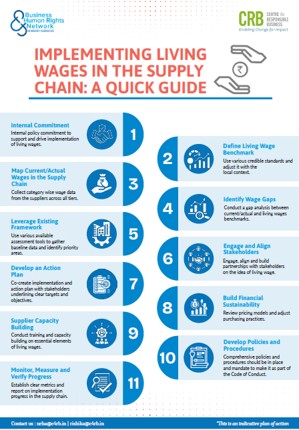
Moving from minimum wage compliance to a living wage requires enterprises to understand where wage gaps exist, what drives them, and what can realistically be done to achieve them.
So, what does the process look like in practice?
Phase 1: Build the Foundation
1.Start with a clear internal commitment
Before asking suppliers to change, businesses need to look inward.
A credible living wage strategy starts with leadership commitment and clear internal ownership. Establish a formal commitment and bring procurement, HR, sustainability and business teams together to align to the cause of why living wages should be adopted. Without internal alignment, living wage commitments can remain disconnected from everyday commercial decisions.
Ask yourself: Is living wage part of our business strategy or simply part of our sustainability policy?
2.Define Living Wage Benchmark
There is no universal living wage figure. The cost of achieving a decent standard of living varies across countries, regions and even cities. Businesses should therefore use credible, independently developed benchmarks to understand what workers need to support themselves and their families. The goal is not simply to increase the number, but to establish a context-specific and credible benchmark against which progress can be measured.
Phase 2: Know Your Position
3.Map current/actual wages across your supply chain
You cannot close a gap you cannot see! Start by building visibility into current wage practices across suppliers and, where relevant, deeper tiers of the supply chain. Collect information on base wages, allowances, overtime, worker categories and gender. The objective is to understand not only how much workers earn, but also how they are paid.
4.Identify and Prioritise the wage gaps
Once the data is available, compare actual remuneration against the relevant living wage benchmark. This can help identify:
- Where the largest wage gaps exist
- Which worker groups are most affected?
- Which regions or suppliers require greater attention
- Where intervention can bring difference
Importantly, prioritization allows businesses to translate from a commitment to a focused action plan.
5.Leverage on Existing Frameworks
Businesses do not need to start from scratch! Existing social audits, supplier assessments, Human Rights Due Diligence (HRDD) processes and wage data can provide a useful foundation. Instead of developing parallel systems, incorporate living wage considerations into existing responsible sourcing and due diligence processes.
Phase 3: Move from Assessment to Action
6. Bring Stakeholders into Conversation
Living wage strategies are more likely to succeed when those closest to the issue have a voice.
Procurement, HR and sustainability teams can help reveal the internal and commercial drivers that shape wage decisions, while suppliers and workers can shed light on challenges at the operational level. The value of engagement lies in understanding the barriers to progress and identifying practical solutions that can work in real-world supply chains.
7.Develop Action Plans
A living wage commitment does not have to mean achieving the full benchmark immediately.
Businesses can work with suppliers to:
- Set Baselines
- Determine Priority
- Develop time-bound actionable targets
- Assign responsibilities
- Define the indicators to measure progress
A phased approach with clear objectives can make the transition more realistic while maintaining accountability.
Phase 4: Enable Suppliers to make the Change
8.Build Financial Stability
Price pressures, short lead times, unpredictable orders and last-minute changes can all affect a supplier’s ability to improve wages. Businesses therefore need to examine their own purchasing practices alongside supplier performance. Introducing living wages may require changes in planning model, price models and purchasing practices.
9.Build Supplier Capability
Suppliers are key to the realization of the living wage strategy. But before asking suppliers to implement changes, it is important to build their understanding of why living wages matter not only for workers, but also for the long-term sustainability and resilience of their businesses. Supplier capability-building can help translate this understanding into practical action through improvements in:
- Productivity and operational efficiency
- Workforce planning and retention
- Wage management and transparency
- Management systems and processes
- Worker engagement and well-being
When suppliers understand the value of living wages and the business case for fair compensation, they can then begin focusing on building the capacity needed to sustain better wages.
Phase 5: Make Progress Measurable and Sustainable
10.Develop Policies and Procedures
A commitment becomes meaningful when it influences decision-making. Living wage expectations and discussions can be woven into supplier codes, responsible sourcing policies, procurement processes, contracts and supplier engagement programmes.
This helps move living wages from a secluded sustainability initiative into a broader responsible business practice.
11.Monitor, Measure and Verify Progress
Finally, businesses need to ask a simple question:
Is the strategy actually improving worker’s lives?
Track progress against the baseline and monitor whether the increased wages have a positive impact on workers. Where possible, combine wage data with worker feedback and other indicators of economic well-being. Reporting should not only communicate what the business has done, but also how it has impacted.
[1] OECD (2024), Handbook on due diligence for enabling living incomes and living wages in agriculture, garment and footwear supply chains, OECD Publishing, Paris, https://doi.org/10.1787/6ff52567-en.
[2] Handbook on due diligence for enabling living incomes and living wages in agriculture, garment and footwear supply chains- https://www.oecd.org/content/dam/oecd/en/publications/reports/2024/10/handbook-on-due-diligence-for-enabling-living-incomes-and-living-wages-in-agriculture-garment-and-footwear-supply-chains_5d7867e7/6ff52567-en.pdf
[3] https://www.unilever.com/news/news-search/2024/living-wage-key-lessons-from-a-decade-of-progress/
[4] https://www.unilever.com/news/news-search/2024/living-wage-key-lessons-from-a-decade-of-progress/
[5] https://www.bea.gov/
“Note: The views and perspectives expressed in this article are those of the author and are intended for general and indicative purposes.”