Promotion of Regenerative Agricultural Practices for a Food Secure and Climate Resilient Future in the EU-India Partnerships
Overview
The project ‘Promotion of Regenerative Agricultural Practices for a Food-Secure and Climate-Resilient Future in EU-India Partnerships’ aims to establish a dynamic multi-stakeholder and participative platform to advance regenerative agriculture.
The project is supported by the European Union and is being implemented by a consortium of partners Solidaridad, CARD and CRB. The primary objective is to strengthen the capacity of Indian Civil Society Organisations (CSOs) to effectively engage with key stakeholders at the local, state, and national levels to foster sustainable, competitive, and resilient agricultural practices. The project supports the transformation to sustainable food systems with a focus on the vegetable oil value chain.
Objectives
The project focuses on key areas such as soil health replenishment, water conservation, biodiversity enhancement, climate resilience, and carbon sequestration. It also prioritises inclusivity, advocating for the equitable participation of women farmers and representation within farmer institutions, as well as underscores the importance of robust and interconnected institutional support to effectively promote and sustain regenerative agriculture practices and their stakeholders.
The larger objectives of the project are:
- Enhance capacity of CSOs to organise and facilitate structured policy dialogues on regenerative agricultural practices at local, state, and national levels
- Strengthen collaboration and consensus at national and local levels to promote regenerative approaches in vegetable oil supply chains
- Foster an enabling environment that drives innovation, builds knowledge through collaborative learning, and provides a platform for stakeholders to scale up regenerative approaches prioritising soil health, biodiversity, and ecosystem services
- Actively engage CSOs in EU-India policy dialogues, focusing on water, biodiversity, regenerative agriculture, and inclusive supply chains, contributing to the effective implementation of the Global Gateway Strategy in India
About NARVOS
The National Alliance for the Regenerative Vegetable Oil Sector (NARVOS) has been established under the EU–India Partnership Programme on “Promotion of Regenerative Agriculture Practices for a Food-Secure and Climate-Resilient Future.” It serves as a dedicated, strategic platform to advance the programme’s objectives within the vegetable oil sector.
NARVOS is not a parallel initiative; it is a core implementation and coordination mechanism designed to translate the programme’s vision into tangible, sector-wide action. The EU–India Partnership Programme places strong emphasis on scaling regenerative agriculture through multi-stakeholder collaboration, policy integration, and market alignment. Achieving this at scale requires a focused, sector-specific institutional platform—one that can bring together farmers, industry, researchers, civil society, and policymakers within a shared framework.
NARVOS fulfils this critical role by providing the institutional architecture needed to align field-level regenerative practices with structured supply chains, evidence generation, and policy processes. By anchoring regenerative vegetable oil initiatives within a unified alliance, it enables systematic coordination, shared learning, and collective decision-making, ensuring that outcomes are scalable, measurable, and sustainable.
Acting as a bridge between on-ground implementation and policy mainstreaming, NARVOS supports the institutionalisation of regenerative agriculture within national strategies and market systems. Through this approach, the alliance ensures that regenerative practices move beyond pilot projects to become integrated, long-term solutions that strengthen food security, enhance climate resilience, and improve farmer livelihoods.
To know more about NARVOS, please click here.
Events
The second expert Group Meeting on “Working Towards Incentives for Regenerative Farmers: Appreciating Multiple Socio-Environmental Benefits and Advocating for Carbon+ Incentives”, was organised under the EU–India funded project “Promotion of Regenerative Agriculture Practices for a Food Secure and Climate Resilient Future”, implemented through the National Alliance for Regenerative Vegetable Oil Sector (NARVOS). The second group meeting was held during the India and Sustainability Standards (ISS 2025) at Bharat Manadapam in November 20205 and the report is available here.
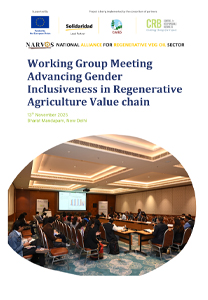
The second expert Group Meeting on “Advancing Gender Inclusiveness in Regenerative Vegetable Oil Value Chain”, was organised under the EU–India funded project “Promotion of Regenerative Agriculture Practices for a Food Secure and Climate Resilient Future”, implemented through the National Alliance for Regenerative Vegetable Oil Sector (NARVOS). The second group meeting was held during the India and Sustainability Standards (ISS 2025) at Bharat Manadapam in November 20205 and the report is available here.
At SOPA 2025, a panel discussion was organised on “Scaling Regenerative Agriculture in India’s Soybean Sector: Building Markets, Incentives, and Policy Convergence”, as well as the forum was utilised as an opportunity to reintroduce and relaunch NARVOS (National Alliance for Regenerative Vegetable Oil Sector) in the Indore circle. The session was deliberately designed to build visibility and engagement around this renewed platform. Please access the full report of the event here.
The “National Level CSO Networking Event under Regenerative Vegetable Oil Program: A Step Towards Net Zero Oilseed Farming”was convened on 27th September 2025 at Bharat Mandapam, New Delhi. Themed “A Step Towards Net Zero Oilseed Farming”, the session created a platform for dialogue among civil society organizations (CSOs), development practitioners, policy experts, Corporate buyers and representatives from financial institutions. The discussions were organized with the objective for a collective recognition that regenerative agriculture, particularly in the oilseed sector, is not only a pathway to climate resilience but also a necessary transformation for ensuring farmer resilience, environmental sustainability, and food security. Please access the full event report here.
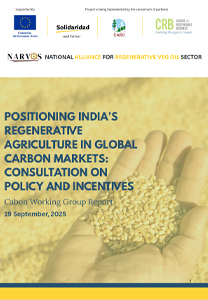
The first expert Group Meeting on advocating for Carbon incentives was organised under the EU–India funded project “Promotion of Regenerative Agriculture Practices for a Food Secure and Climate Resilient Future”, implemented through the National Alliance for Regenerative Vegetable Oil Sector (NARVOS). The first meeting was organised on 19th September, 2025 at The Lalit, New Delhi and the report is available here.
The first expert Group Meeting on advancing gender inclusiveness in regenerative vegetable oil value chain was organised under the EU–India funded project “Promotion of Regenerative Agriculture Practices for a Food Secure and Climate Resilient Future”, implemented through the National Alliance for Regenerative Vegetable Oil Sector (NARVOS). The first meeting was organised on 19th September, 2025 at The Lalit, New Delhi and the report is available here.
The event was organised as the first step towards engagement with the demand-side stakeholders of the vegetable oil sector to promote regenerative agriculture with specific reference to the vegetable oil. In the event, the project’s objectives – which is to encourage farmers to adopt regenerative practices to improve the soil health, climate, biodiversity, water, and promote gender equality – as well as benefits of sourcing vegetable oil from regenerative agricultural practices, were shared with the demand-side participants.
The event provided a unique opportunity for demand-side stakeholders — those involved in sourcing, processing, and marketing vegetable oils — to gain insight into the practical applications and advantages of regenerative agriculture. By bringing together stakeholders from both the supply and demand sides, the event fostered collaboration and developed a shared understanding of how regenerative practices can be scaled up within supply chains. This is an important step towards creating more sustainable, transparent, and resilient vegetable oil sourcing practices.
i. What are your opinions on regenerative agriculture? What are the opportunities and challenges for: Farmers, Government, Mandi, CSOs, and Traders?
iii. What are the expectations of farmers from the government and traders for increasing agricultural production and marketing of crops? What is the role of the Mandi in this?
iv. What kind of training and capacity building do farmers require to adopt regenerative agriculture on a large scale?
The Centre for Responsible Business (CRB) hosted a dedicated Regenerative Agriculture Booth at the World Food India event held from 19 to 21 September 2024. The booth served as an active platform for engagement with a diverse set of stakeholders, including farmers and Farmer Producer Organisations (FPOs), agribusiness professionals, government officials, NGOs, academics, researchers, and corporate representatives from CSR and sustainability teams.
The booth significantly enhanced awareness of regenerative agriculture among attendees and facilitated meaningful dialogue with stakeholders exploring collaborative opportunities. The interactions at the booth opened up valuable networking avenues and offered fresh insights into the challenges and opportunities shaping the regenerative agriculture landscape. Read the report here.
Field Visits
Insights
Video Insights
For further information, please contact
Rajat C
Senior Programme Officer,
Centre for Responsible Business
Email: rajat@c4rb.in
Phone: +91 9833670008
Chhanda De
Programme Officer,
Centre for Responsible Business
Email: chhanda@c4rb.in
Phone: +91 7602501434